USE CASE - MARKETING

How Marketing Teams use B2B Intent Data to See What  Drives Pipeline

Start showing revenue impact from your marketing strategies.
Marketing drives the leads, but without knowing which ones actually evaluated your product, half the budget goes toward traffic that was never going to buy. Subflare gives your team b2b intent data on every lead before the first sales call, so you can prove which campaigns produce pipeline, not just form submissions.

Subflare Gives you the Story Behind the Form Submission

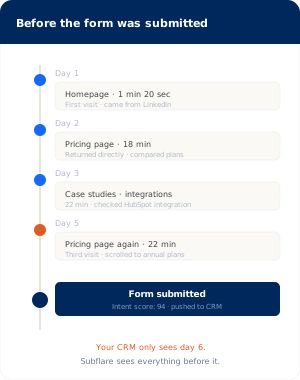
When a lead fills out a form, your CRM captures a name, an email, and maybe a company. That is everything your sales team has to work with. What it doesn't capture is the 40 minutes that lead spent on your pricing page — or the fact that they came back four times before converting.

That behavior tells you something a form never will. Without it, your sales team treats every lead the same and wastes time on people who were never going to convert.

How Subflare Works for Marketing Teams

Most marketing tools stop at the form. They tell you where the lead came from, which ad they clicked, which page they landed on. Subflare picks up everything that happened before that: every page visit, every return session, every minute spent on pricing. That behavioral history gets pushed straight into your CRM the moment the form is submitted.

Your demand gen team can finally answer the question that comes up in every pipeline review: which of our campaigns is actually producing buyers, and which is just producing noise. You can filter leads by intent score, trace high-intent leads back to their source campaign, and use that data to make a case for where budget should go next quarter.

Setup takes fifteen minutes. You add a small tracking script to your website, connect your CRM via Zapier, and Subflare starts building behavioral profiles immediately. There is no new dashboard to check. The data lands directly in the fields your sales team already looks at on every contact record.
Intent score by campaign source 100% 75% 50% 25% 0% 28% Paid Search 142/mo 54% LinkedIn Ads 67/mo 88% Blog Content 18/mo Best ROI 71% Webinar 31/mo

B2B intent data that shows what your MQLs actually mean

Subflare scores every inbound lead based on pre-form behavior, not firmographic data. That means your team stops fighting over whether a lead is sales-ready based on job title and starts making that call based on what the person actually did on your site. That is b2b intent data your CRM has never had before.

15 min

average setup time

5000+

CRM integrations via Zapier

0

manual exports needed

Questions from Marketing Teams

We already have attribution. What does Subflare add?
Attribution tells you where a lead came from. Subflare tells you what they did after they arrived. A lead from your best-performing LinkedIn campaign might have spent 30 seconds on your site and never come back. Another from an old blog post spent 12 minutes on pricing and returned twice. Attribution treats them the same. Subflare does not. The combination of source data and behavioral intent data is what gives you a complete picture.
How does it fit into our existing lead scoring model?
Subflare does not replace your lead scoring setup, but instead adds first-party behavioral data on top of whatever model you already run. Your scoring gets sharper because it is working with richer inputs. The data lands in the same CRM fields your team already uses, so nothing about your workflow changes. Most teams find that their existing scoring becomes significantly more accurate within the first month.
Does Subflare work with our existing marketing automation?
Yes. Because Subflare connects via Zapier and writes to your CRM, it works alongside whatever marketing automation stack you already use. HubSpot, Marketo, ActiveCampaign, and most other platforms pull data from the same CRM fields Subflare writes to. You do not need to change your automation workflows.
Can this help us justify budget for specific channels?
Yes, and this is where most marketing teams will find the most immediate value. Once you can see which channels produce high-intent leads rather than just high volumes, the budget conversation changes entirely. You stop defending cost-per-lead and start talking about cost-per-serious-buyer. That is a much easier number to defend in a planning meeting.
How long before we see meaningful data?
Most teams see their first intent scores within hours of setup, but the model keeps improving as more data comes in, so it gets more useful over time.
What if our sales team does not trust the scores?
The best approach is to start by showing sales reps the behavioral detail behind each score rather than just the number. When a rep can see that a lead visited pricing four times and read two case studies before submitting, the score feels earned rather than arbitrary. Most teams find buy-in comes quickly once the first few high-scoring leads turn into real conversations.

Ready to know which leads are worth calling?

Book a demo and we will show you exactly what your sales team would see when a lead converts.