USE CASE // SALES

How Sales Teams use Subflare to Identify and Close High-Intent Leads

Stop following up blind. Know exactly who is worth calling before you pick up the phone.
Every sales team has the same problem. Inbound leads arrive, someone follows up, and half the calls go nowhere. Not because the reps aren't good — but because nobody knows which leads are actually serious.

Your inbound process is working. Your lead intel isn't.

When a lead fills out a form, your CRM captures a name, an email, and maybe a company. That is everything your sales team has to work with. What it doesn't capture is the 40 minutes that lead spent on your pricing page — or the fact that they came back four times before converting.

That behavior tells you something a form never will. Without it, your sales team treats every lead the same and wastes time on people who were never going to convert.

How Subflare works for sales

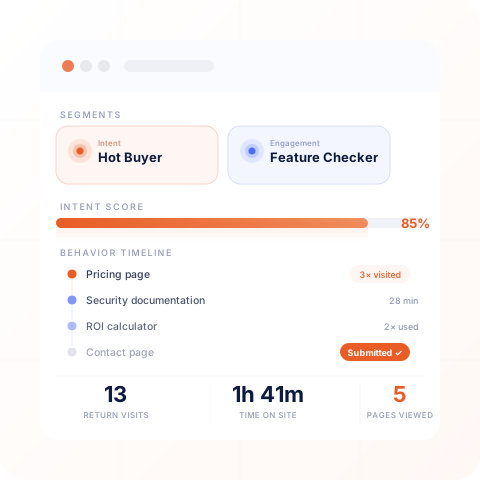
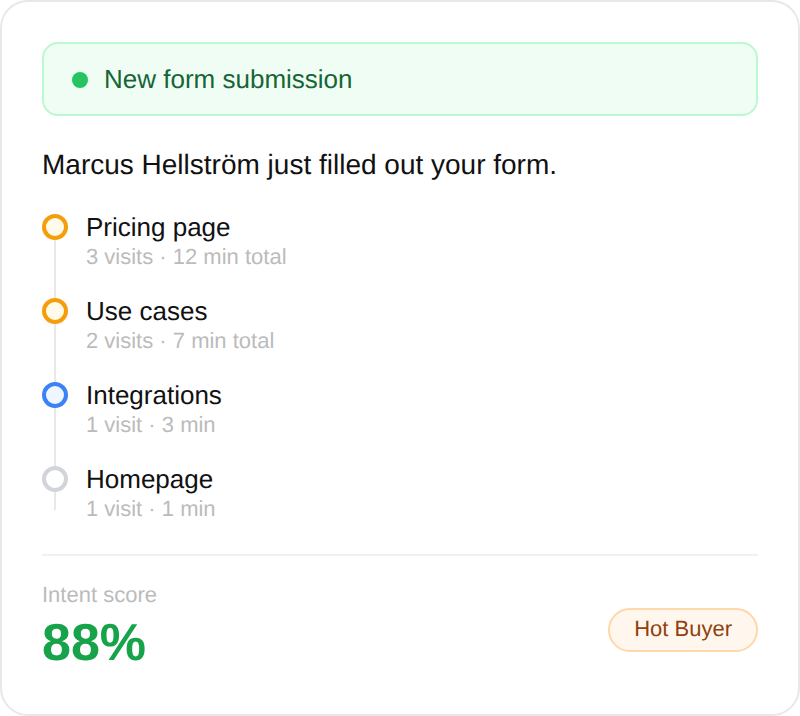
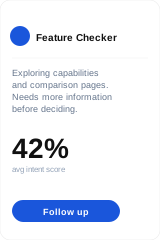
The moment a lead submits a form, Subflare pushes their full behavioral history to your CRM. Your rep opens the contact and already knows which pages they visited, how long they spent on pricing, and an AI intent score based on all of that behavior.

None of this requires a new tool. It lands in the CRM your team already uses, via Zapier, before the first call happens.

AI lead scoring that tells you who to call today

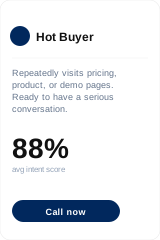
Not every inbound lead deserves your attention this week. Subflare's AI scoring separates them automatically — looking at pages visited, time on site, return visits, and engagement patterns to give each lead a score your team can act on immediately.

15 min

average setup time

5000+

CRM integrations via Zapier

0

manual exports needed

Questions from Sales Teams

How is this different from a regular CRM enrichment tool?
Most enrichment tools add firmographic data — company size, industry, revenue. That tells you who the lead is. Subflare adds first-party behavioral data — what this specific person did on your website before converting. That tells you whether they are ready to buy right now. Firmographic data is the same for everyone at a company. Behavioral data is unique to the individual and far more predictive of close rate.
How accurate is the AI lead scoring?
The model analyses pages visited, time on site, scroll depth, and return visits. Most teams find the scoring reliable enough to use as their primary signal for daily lead prioritisation within the first week. Accuracy improves over time as the model learns from your own pipeline data — which deals closed from which behavioral patterns. There is no minimum data requirement to get started.
How is Subflare different from other sales intelligence tools?
Most sales intelligence tools start with third-party data — company databases, intent signals aggregated from across the web. Subflare starts with first-party data from your own website. That means every signal is specific to your product and your visitors, not a proxy built from someone else's traffic. The result is a scoring model that gets more accurate over time as it learns from your own pipeline, not a generic model built on industry averages.
Does it work with our existing lead qualification process?
Yes. Subflare adds a behavioral layer on top of whatever process you already use. The data flows into your existing CRM fields, so your team works exactly as they do today. You do not need to rebuild your qualification framework or retrain your reps. Most teams integrate it in a morning and see their first scored leads by the afternoon.
Can we customise which pages signal high intent?
Yes. Subflare's segmentation logic is configured around your specific sales process and the pages that matter most for your product. You decide what counts as a high-intent signal — whether that is time on pricing, visits to a specific use case page, or repeat sessions within a set window. You install the script and it starts tracking. Configuration takes about fifteen minutes.
What happens to leads that score low?
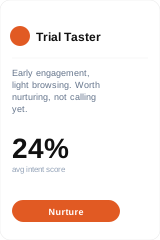
Low-scoring leads do not disappear. They stay in your CRM and Subflare continues tracking their behavior. If a lead that scored 20 today comes back to your pricing page twice next week, the score updates automatically and your team gets notified. Most sales teams find this useful for deals that go quiet — rather than chasing manually, they let the intent score tell them when a prospect has re-engaged and is worth calling again.

Ready to know which leads are worth calling?

Book a demo and we will show you exactly what your sales team would see when a lead converts.