.svg)
What qualification actually requires
Good lead qualification isn't just about whether a company fits your ICP — it's about whether they're ready to buy right now. A perfect-fit company that's eighteen months away from a decision is very different from a slightly-less-perfect company that's actively evaluating options this week and needs to make a call by end of month.
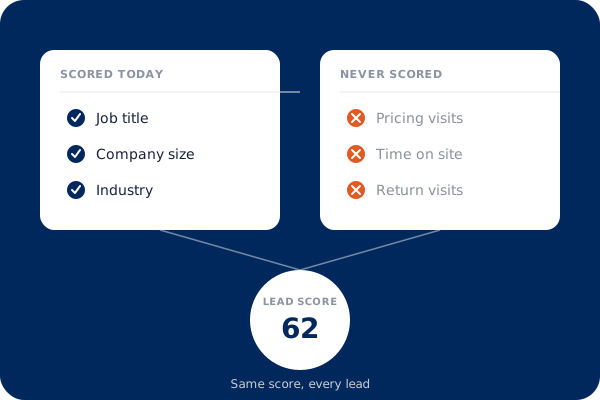
Other lead qualification frameworks designed to help reps figure out readiness during a conversation, and they work reasonably well once a conversation has started. The problem is that buying readiness doesn't become visible only when someone submits a form. It shows up in behavior long before that moment. The research visits, the pricing comparisons, the return trips to your documentation — those are buying signals that tell you exactly how serious a prospect is. Most B2B sales teams just can't see them.
Monday morning, five demos booked
Your sales rep opens their CRM on Monday morning. Five demos booked for the week. Five companies who filled in a form, said they were interested, and picked a time slot.
The rep knows their name, their company, their job title. Maybe there's a note about what they said they were looking for in the message field. That's it — five conversations to prepare for, and almost nothing to go on.
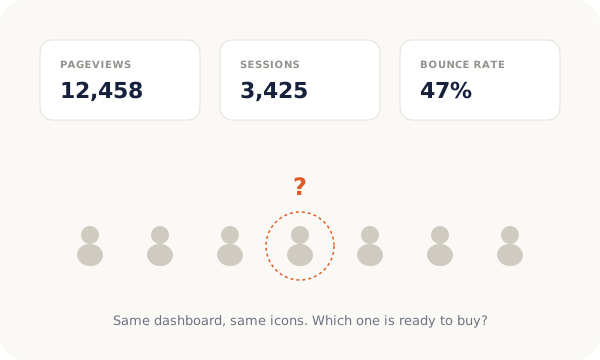
So they go in the same way every time. Introductions, discovery questions, a product walkthrough. They treat each demo more or less the same because they have no real reason to treat them differently. One of those five companies visited your pricing page six times last week and had three people from their team on your site in the same month. Another clicked an ad, spent forty seconds on your homepage, and booked a demo on impulse. Your rep has no idea which is which.
That's not a rep performance problem. That's a lead qualification gap.
The information that disappears at the form
There's a specific moment where a lot of useful context gets lost, and it's the moment the form gets submitted.
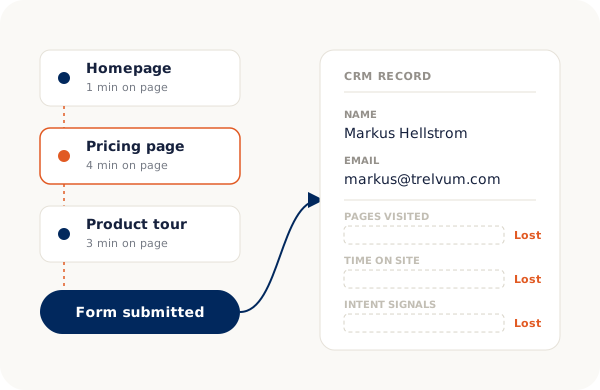
Before the form, a prospect's behavior on your website tells a detailed story. Which pages they visited, in what order, how long they spent, whether they came back, whether colleagues from the same company joined them. After the form arrives, that story collapses into a name, an email address, and whatever they chose to type in the message field.
Your sales rep gets the collapsed version. The detailed version — the one that shows this company has been evaluating seriously for three weeks, has visited pricing repeatedly, and had their Head of Sales on the site yesterday — is gone by the time anyone picks up the phone. This is exactly the problem that what most B2B lead scoring models are missing describes from the scoring side, and our post on why traditional analytics miss buyer intent explains why standard tools can't capture it.
The detailed version — the one that shows this company has been evaluating seriously for three weeks — is gone by the time anyone picks up the phone.
How to identify anonymous website visitors before they convert
The practical question is how to capture this behavioral layer before the form arrives. Company-level website visitor identification — matching anonymous traffic to real organizations based on IP and behavioral data — makes it possible to see which companies are on your site, what they're doing, and how their behavior patterns compare to companies that have converted in the past.
Subflare tracks visitor behavior before form submission and scores buying intent based on the signals that actually predict conversion — pricing visits, return visits, documentation engagement, multi-stakeholder activity. That data feeds directly into your existing workflow via CRM and tool integrations, so your reps see it where they already work rather than having to check a separate dashboard.
The result is that sales lead prioritization stops being a judgment call made on incomplete information and starts being based on what prospects actually did before they got in touch. For teams handling high volumes of inbound traffic, that shift changes how every Monday morning starts.
Ready to see who's in your qualification gap right now? See Subflare's founding customer plans →
.svg)